What kind of water purifier is good and meets of families needs?

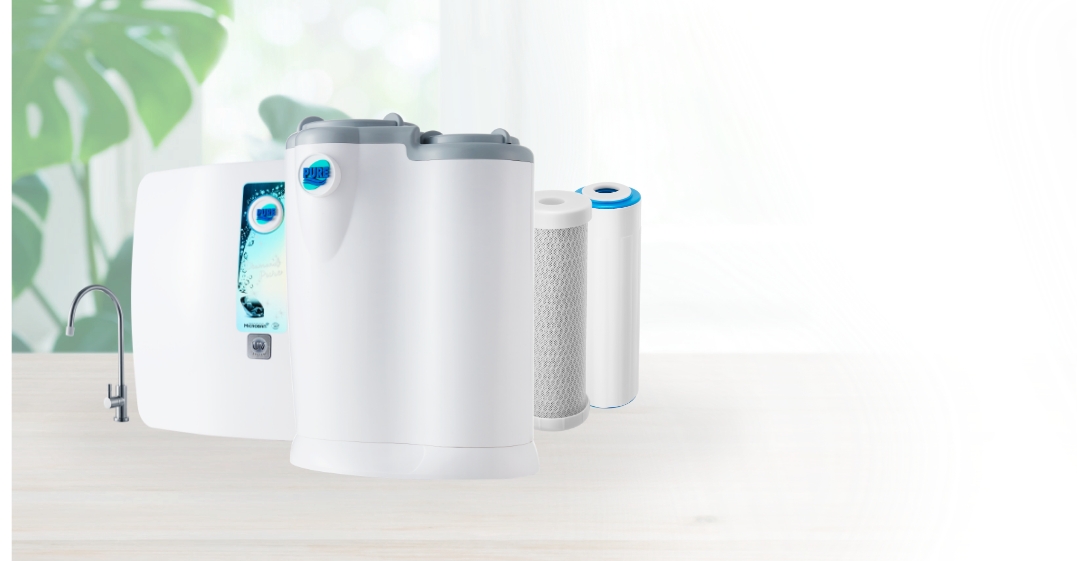
Before choosing the best water purifier, you must know the nature of the water that will pass through the purifier, such as groundwater or tap water, in order to select the right filter for the water. In addition, you must know the number of members in the house in order to select a water purifier with enough water production capacity per day. Water purifier for household purposes can be roughly divided into 2 types: water purifier suited for water for use and water purifier suited for drinking water. • The water purifier suited for water for use is intended for filtering tap water or groundwater before entering residential water supply piping system. It removes minerals and impurities that may enter the system and cause clogging in the pipes or cause the pipes to rust. It is often used in combination with water pump and water supply tank. • The water purifier suited for drinking water is a higher quality water purifier with a multi layer filtration system. It removes particles and impurities. Some of its models have antimicrobial properties. It is designed to be connected to water tap fittings for filtering household drinking water.

How to choose a water purification system?

1. Know the components of household water First of all; we need to know the composition of the water used in our home. If it is tap water, it has been treated to a certain extent; but if it is water from a natural water source especially groundwater, there will be more minerals that need to be filtered out, such as nitrates, fluoride and odors. In addition it is required to use a water purifier that can kill various microorganisms. 2. Know the purpose of the water to be used If you want clean water for drinking, you need to choose a high-quality water purifier; but if you want water for bathing or other consumption, you may use a normal non-expensive water purifier to filter only sediment and smell. 3. Know the filter of the selected water purifier Consumers should inquire about the filters used in different models of water purifiers to know their filtration and disinfection properties and check whether they match the purpose of usage. For example, if you want pure water for drinking without having to boil the water again, a water purifier that can kill microorganisms should be your choice. 4. Compare prices of water purifiers from different brands The prices of different brands of water purifiers with the same feature should not be much different. Some brands include after-sales warranty together with filter replacement service according to the service life because they meet the needs of consumers of after-sales services. 5. Choose a water purifier that meets industry standards Don't just look at brands and prices; you should pay attention on standard marks endorsed by the Ministry of Industry to confirm the preliminary safety.

Water purifier standards that you need to know

Water is considered an important factor in the lives of humans; therefore, we should choose to drink clean and safe water. Water purifiers are produced as device to help remove contaminants from drinking water and the installation of a water purifier for home use is the best and easiest way to filter and clean water. Therefore, choosing a water purifier for home use is important. However, the selected water purifier should be certified and meet internationally recognized standards. Before deciding to buy a water purifier, we should first know the water purifier standard and its evaluation criteria. NSF International follows American National Standards Institute (ANSI) to sets NSF/ANSI standards for properly evaluating efficiency of water purifiers; and they have been accepted in many countries. NSF International analyzes the following factors for certifying water purifiers as follows: Physical Effects: Test the efficiency of water purifiers in reducing the amount of contaminants that affect taste, odor and clarity of drinking water, Health Effects: Test the efficiency of water purifiers in reducing the environmental contaminants including lead, asbestos, volatile organic compounds and pesticides in drinking water, Ultraviolet light treatment on microbiological safety: Test on a water purifier that uses ultraviolet light to eliminate microorganisms in drinking water.

How is the use of an RO system different from those of regular filtration?

RO filtration system is intended to separate out the high concentrations of solutes in the water. It is often used in groundwater source areas, coastal areas or areas with brackish water problems in order to separate the solutes to leave water suitable for drinking; whereas filtration in other systems cannot do.

What is the difference between UF membrane and RO membrane filter?

The UF filter is a type of membrane filter and has its pore size of 0.01 microns. (RO membrane 0.0001 microns). UF can filter contaminants, microorganisms and bacteria that contaminate water. It can also retain useful minerals in the water. UF has no discarded water.

Isn't it good for an RO system to filter out all the minerals?

Normal water contains few minerals that we need. Therefore, we do not have to be afraid of mineral deficiencies from drinking RO water because almost all of the minerals we receive come from the food we eat; and almost all bottled drinking water sold in the market is RO water.

Is the water purifier suited for water for use necessary for tap water?

Nowadays, most houses have water tanks to store water for use all the time, but these large tanks often are not cleaned; contaminants get into the water and accumulate inside the tanks. After a long time, these contaminants enter a house and cause a blockage in faucets and electrical appliances and accumulation of stains on various sanitary wares. The installation of a water purifier suited for water for use reduces the accumulation of these impurities and prolongs the cleaning periodicity of the water tank.

So what can a water purifier suited for water for use filter?

Water purifier suited for water for use with Zeolite filter media can filter debris, dirt, sediment and dust mixed with water, reduce iron stains and scale adhering to sanitary ware, help absorb the smell of ammonia or rotten egg gas, and make the water cleaner and more pleasant to use.

How much water pressure is required for a water purifier?

The purifier can withstand the water pressure of 4 Bar, while the pressure of tap water is usually not more than 1 - 1.5 Bar. However, when a water purifier is installed in a customer's house with a water pump or in a condominium, there will be more water pressure. It is recommended to measure the water pressure before installation. If there is a high water pressure (from about 3 bar or more), it is recommended to install a water pressure reducing valve to reduce the expansion of the water filtration cylinders that has to withstand retaining water pressure for a long time. As for the problem of high retaining pressure in the cylinders, at first there might not be a leak in the cylinders. When they are used for a longer time, the retaining pressure will push the cylinders to expand. Therefore, when a water purifier is installed with high-pressure water, it is also desirable to install a set of pressure relief.

What causes slow running water?

After using the water filter for some times, the filter will normally be clogged and the slowly running water will occur. However it is necessary to check the filter life, to check whether there is a bending stream of water and the tap water pressure is normal or not, because sometimes the slowly running water is not only caused by a clogged filter.

How much water pressure is required for a water purifier?

The purifier can withstand the water pressure of 4 Bar, while the pressure of tap water is usually not more than 1 - 1.5 Bar. However, when a water purifier is installed in a customer's house with a water pump or in a condominium, there will be more water pressure. It is recommended to measure the water pressure before installation. If there is a high water pressure (from about 3 bar or more), it is recommended to install a water pressure reducing valve to reduce the expansion of the water filtration cylinders that has to withstand retaining water pressure for a long time. As for the problem of high retaining pressure in the cylinders, at first there might not be a leak in the cylinders; but when they are used for a longer time, the retaining pressure will push the cylinders to expand. Therefore, when a water purifier is installed with high-pressure water, it is also desirable to install a set of pressure relief.

Why does an RO system need a drain? How much water does the RO system drain? How much purified water does the RO system produce?

Reverse osmosis (RO) is a water purification process that uses a membrane to separate pure water molecules from other substances and the contaminated water will enter the drainage system. The finest filter reverse osmosis membrane has the pore size of 0.0001 microns. Generally a system's production rate is about 40% and 60% of water is discarded.

After using a water purifier for some time, although it is yet not time to change its filter, why is the water running slowly?

Each area has different water conditions. Some areas may have more turbid water than others. As a result, the filter becomes clogged faster than its specified service life. In this regard, it may be advisable to install an additional coarse filter to prolong the service life of the filter.

Why does filtered water smell like chlorine or have a weird smell?

Carbon filter is very effective at adsorbing odors and chemicals. Therefore, if the water that passes through a water purifier has a smell, it means that the filter has deteriorated from long use, or there is a crack inside the filter, such that the water that does not pass through adsorbing carbon comes out, or the water contains a lot of chlorine, thus making the filter short-lived. It is recommended to install additional carbon filters or replace the carbon filters when there is an odor or use an RO system instead. However, tap water will come with chlorine to kill germs or there may be rust from the plumbing. Some seasons the water may taste salty, and sometimes there may be foreign matter from broken plumbing or plumbing repairs.

Why does water smell weird when I turn on my faucet after not being used for a long time?

When a water purifier is not used, there will be remaining water in the cylinders. When there is no water to replace it for a long time, it may cause odors, which is normal. Therefore, before water filtration, you should drain this water for about 1-2 minutes, the smell will disappear. If it does not disappear, the filter may expire or the filtering efficiency of the filter may deteriorate. Therefore, the filter should be replaced.

The filtered water initially tastes sweet. Why does it have less sweet taste after using a water purifier for a long time?

In the production of activated carbon filters, high temperature heat is used to form a cartridge such that the surface of the carbon filter becomes more alkaline. The filter in alkaline pH range will give the water a rather sweet taste; but when it has been used for a longer time, its alkalinity will be reduced to neutral pH range. Therefore the sweet taste decreases and we feel that the taste changes. This is typical for the use of water purifiers. Another cause is the reduction in efficiency of a resin filter in adjusting water condition.

Why does a white scale occur after the water is boiled or frozen?

Water naturally contains compounds such as calcium and magnesium that are beneficial to the human body. If these substances are in large quantities and then are boiled or chilled, they will transform into solid state and bind with metal, that we call scale. The main compound that causes scale is limestone. *As for a way of solving the problem, this problem is usually caused by the filtration of high-hardness raw water; therefore, it is advisable to use additional resin filter in order to reduce the hardness. In case that the resin filter is already used, the cause is the deterioration of ion exchange capacity of the resin beads. The filter must be washed with 10% saline water to restore the ion exchange capacity for about 25 - 30 minutes or the filter must be replaced.

How often should a filter be changed?

It is recommended to change the filter every year to maintain the water quality standards.

How to clean for each filters types?

- The PP filter can be cleaned by removing it and spraying water to clean its exterior surface. Do not use hard brushes or scouring pads on it because they could easily damage its surface. - The 0.5 and 0.3 micron carbon block filter can be cleaned by removing it, spraying water to clean its exterior surface, using a soft-bristled brush, such as a toothbrush, to scrub the dirty areas, and then assembling it in place. - The resin filter can be cleaned by soaking the filter in 10% saline water (100 g salt / 1 liter of water), shaking the resin beads inside such that they rub against one another for discharging ions in order to restore filter efficiency and soaking time takes about 25 – 30 minutes, then rinsing it with water to remove the stinging saltiness and assembling it in place and checking whether the filter is inserted correctly.

What causes slow running water?

After using the water filter for some times, the filter will normally be clogged and the slowly running water will occur. However it is necessary to check the filter life, to check whether there is a bending stream of water and the tap water pressure is normal or not, because sometimes the slowly running water is not only caused by a clogged filter.

How do I know that it is time to change my filter?

Normally, the company has a notification system to remind a user of upcoming due date for filter replacement. Mainly the replacement will be in accordance with the filter life. However, during the use, if there are any abnormalities such as a chemical smell in the filtered water, a slower water flow rate, it should be time to replace the filter.

What caused the water in a bottle to turn green?

Problems of this nature are often caused by a container which has been contaminated or has been reused repeatedly. The reaction may be catalyzed by the environment such as suitable sunlight or temperature and it will cause algae to occur. It is recommended to use containers only for water and keep them in a dry place and out of the sunlight. Moreover, a lot of water should not be stored at a time, it is more appropriate to use a water purifier regularly.

After turning on filtered water, I found a fiber film that looks like white jelly. What is the cause?

In this matter, it is likely caused by bacteria that have accumulated in the water passage and held together to form a thin sheet which is called Biofilm. When water passes through it, it will come off with water. It is found at installation area near a dishwashing sink or a place where bacteria can spread easily and water is not frequently used. As for a way of solving the problem, the outside of water hose or faucet must be cleaned with disinfectant, and the inside of water hose must be cleaned with hot water.

When the filtered water is chilled, sometimes I see white flakes in the water

In the production of activated carbon filters, high temperature heat is used to form a cartridge such that the surface of the carbon filter becomes more alkaline; and when the water is chilled, white flakes will appear. The alkalinity of this carbon will gradually decrease by regular use of it. As for a way of solving the problem, when a new filter is used, the filtered water should be discarded for about 10 - 15 minutes such that the carbon filter will adjusted to the neutral pH range.

How do I know that it is time to change my filter?

Normally, the company has a notification system to remind a user of upcoming due date for filter replacement. Mainly the replacement will be in accordance with the filter life. However, during the use, if there are any abnormalities such as a chemical smell in the filtered water, a slower water flow rate, it should be time to replace the filter.

What are the consequences if I use the filter beyond the normal replacement period?

As for the recommended filter replacement period, there is a test that it is an appropriate period. Using a filter beyond the replacement period may cause us to drink water from a filter with deteriorating performance, and the water is not as clean as it should be.